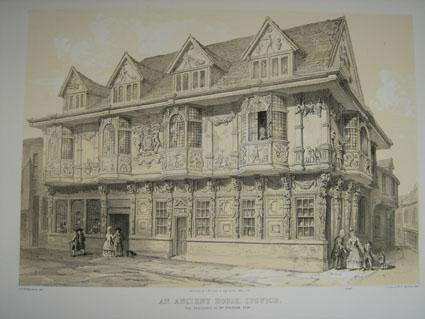
The evening light, yellow from heavy snow clouds gathered over the town, blurs the sparkle of the Christmas stars, bells and reindeer strung across the square. Their colours bleed into the air like water paints too quickly daubed upon the canvass.
Ancient House hasn’t changed. Four panels depicting the known continents of the 17th century still adorn the walls between the latticed bay windows and the carved woodwork supports of the upper floor. Its majesty takes Eleanor’s breath away, just as it did the first time she saw it, all those years ago, when she’d nearly lost her nerve. A different fear snakes through her today; a fear she bundles into the shadows of her mind. The coins in her pocketed hand, smooth from years of rubbing, give her the courage she needs. She treads carefully through the slush towards her destination, ignoring the cold aching through her toes.
Shop assistant Maggie turns the sign on the door to ‘closed’. She lingers, holding the door against her to keep off the worst of the cold, as she listens to the band play ‘Once in Royal David’s City’. She rubs her hand up and down her arm. The evening shoppers, laden with bags and packages, battle the snow. Six days till Christmas. Maggie’s shopping is all done, the presents wrapped. She congratulates herself on her organisation. No last-minute panic buying for her. The brittle air needles into her skin. Icy flakes settle on her eyelashes.
She shuts the door, pushes the bolt across, stamps her feet and rolling her tired shoulders, turns to find the old woman standing at the foot of the stairs. Irritation flushes through her; she could have sworn the shop was empty.
‘Excuse me, madam. The store is closing. Please make your way to the till so we can deal with your purchase.’
Eleanor Trent, silver-haired and plump like a storybook grandma, stands in the homeware shop, disappointment gnawing at her gut. Over the crook of her elbow hangs a battered handbag large enough to carry a small dog. She regards Maggie with kind brown eyes. ‘What’s upstairs?’
The shop assistant, all of fifteen, thinks Eleanor, addresses her with the faux courtesy youngsters believe is so beloved by the older generation.
‘Not part of the shop, madam. It’s where we keep our stock.’
‘Is it off-limits to customers?’ Eleanor’s voice doesn’t betray the hope burning in her heart. She strokes the bag, her arthritic hand tense. Surely they’d understand, if she explained?
Maggie tries to be polite. ‘It is, I’m afraid. I can go up, should you wish to purchase something not on display.’
‘I don’t want to buy anything.’ Eleanor gestures to the stairs. ‘I want to go up there. Are you the manager?’ It’s a stupid question, given the girl’s youth, but Eleanor’s nerves make her say silly things. It was always this way.
‘No. Would you care to speak to her?’ She cannot keep the resignation from her face, nor the exasperation from her voice. ‘I’ll get her.’
‘Thank you.’
While Maggie fetches the manager, Eleanor peeks up the stairs. The walls are still painted cream, and the stairs still bend slightly to the left as they reach the upper floor.
She closes her eyes and loses herself in its familiar smell.
‘Can I help you, madam?’
Eleanor twists, her boots whining on the laminated floor. The manager, a haughty woman of about fifty, smiles a professional smile. A name tag on her lapel shrieks ‘Brenda’.
‘I hope so. Would it be possible to go upstairs?’
‘That’s for staff only. May I ask why?’
‘I used to work here, many moons ago–when this was a book shop.’
‘Really?’ She raises an arched brow, now genuinely interested. ‘I didn’t know it’d been a book shop. But I’m not local.’
‘So, would you break the rules, for my sake? I won’t be very long.’
The manager scans the shop. Eleanor is the only customer.
‘All right, just a couple of minutes. We are closed, you know. Let me show you the way.’
‘No need. I know the way.’
A call from Maggie at the far end of the shop echoes through the deserted aisles, and Brenda apologises. ‘There seems to be a problem. Do excuse me.’
Eleanor takes her first step. The stairs are steeper than she remembered, narrower, too. Her hips complain as she hauls herself from stair to stair. She is puffing for breath by the time she reaches the top where an ugly fire door has replaced the original; a heavy wooden creation, resplendent with carvings. Eleanor pushes against it with her shoulder and, after a small protest, it slinks open. She gasps.
The room is just as she remembered. On the far side, colours from the outdoor Christmas lights are cast across the floor from the slim bay window, its leaded glass distorting the throw of the beams to create unusual pools between the book-laden shelves.
She takes a step and the fire door creeps shut behind her. The scent of leather, paper, ink and books, like dry fog, fills the room. Eleanor wants to reach out and grasp some in her hands, pull it to her face and engulf herself. Overhead, a single electric light hangs from a flex stretched across the ornate ceiling, casting its feeble glow over the glass cases, where displays of writing boxes gleam. Crossbeams bedecked with plasterwork flowers extend from one side of the room to the other and between them, wreaths of more flowers, all somehow alive in the rainbow of light.
Eleanor tiptoes further into the room, past the displays of photograph albums and fountain pens, picture frames and writing paper, her senses alive with memories. She stands motionless, letting the past besiege her.
*
She’s eighteen, on her first day in charge. To celebrate her newfound responsibility, her wrist and neck glow with her mother’s vanilla scent – sprayed furtively before leaving home- its aroma heady in the closeness of the shop. Alone, after a lecture guaranteed to stifle the interest of any but the most ardent sales assistant, she scans the shelves for something to read while she awaits her first customer. The Salvation Army band in the square plays ‘In the Bleak Mid-Winter’; Eleanor’s favourite. She pulls out a slender tome – ‘A Christmas Carol’ -makes herself comfortable, as much as she can on the upright chair in the bay window, and begins to read.
The shop fades from her consciousness. Scrooge prowls the foggy streets, passers-by recoil and his footsteps echo on the cobbles. She shudders. How dark, how uneasy his home, as he sits before the fire to eat his gruel.
‘It was a very low fire indeed; nothing on such a bitter night. He was obliged to sit close to it, and brood over it, before he could extract the least sensation of warmth from such a handful of fuel.’
‘That’s what I like to see. What’re you reading? Should I buy it?’
Eleanor leaps from the chair. The book tumbles to the floor, to land like a stranded bird, its wings akimbo. The ancient man, dressed in those antiquated clothes, must be one of the carol singers from the street. He bends to pick up the book, and reads the title on the spine. He smiles, his eyes brimming with mischief.
‘Is this Dickens fellow any good?’
‘Yes, sir. I’ve read it lots of times and never tire of it. Look at the pictures. They may be old-fashioned, but they are wonderful.’
He fishes in his pocket for a couple of coins.
‘I’ll take it. Can you wrap it for me?’
It’s an unusual request. There are bags under the till, but Eleanor isn’t sure if there’s any paper, or sticky tape.
‘Um, I don’t know. It’s my first day in charge. Let me check.’
She scurries to the till and searches the untidy shelves beneath. ‘Ah-hah! We have paper, and, oh, string.’ She stands, holding out the items in her hands for him to see. ‘Will this do?’
‘Charmingly. Thank you. It’s a gift, you see. May I just write a dedication before you do the honours?’
‘Of course, sir. Would you like to borrow my pen? ’She delves into her handbag and offers him her most treasured possession–the fountain pen her grandmother used to write her poetry. If her mother knew she’d brought it with her, she would be furious, but Eleanor wanted a good luck token.
He takes it from her, his face a study of curiosity and bemusement. He holds it aloft and looks at it from every angle, runs his fingers along its slender barrel. ‘What a fascinating instrument.’
‘Let me take the lid off–it’s so old it can be a swine.’
He places the pen in her hand and watches her as she unscrews the top, pops it on the end of the barrel and hands it back.
The nib glints, subtle gold under the inky point, the engraved pattern on its back in delicate relief after years of use. Eleanor sighs. To her, it is the most beautiful of objects.
The gentleman takes a fob watch from his chequered waistcoat pocket, gives it a glance and slips it back. He places the book on the desk by the till and scrawls a hasty message. His signature is written with a flourish, the letters curly and his two names running together. Eleanor tries to read them but, upside down, they are illegible. Beneath, he finishes with several underscores which look like a small boat supporting his words. He closes the book with a snap and holding it in his refined hand, offers it to her.
The book is soon wrapped, bound by string which Eleanor ties in a tight knot. She cuts off the ends with a clunky pair of scissors.
‘There you are.’ She holds the book, her arm out-stretched, but he doesn’t take it. ‘That’s 40p, please.’
He drops the coins into her hand where they glimmer like old treasure. She makes up her mind in the instant. As soon as he has gone, she’ll take the money from her purse and replace the coins. She doesn’t want a scene on her first day; besides, he’s buying it for a gift.
The coins deposited in the till drawer, she smiles at him. ‘Thank you, sir. I hope the person likes the book as much as I do.’ She offers it to him, again.
‘I’m sure of it. The book is my gift for you, on your first day in charge. I hope you read it many times in the years to come.’
‘Oh, but I can’t accept-’
‘Of course you can. I won’t hear another word. It has been a delight to meet you, Miss Eleanor Trent.’ He bows, and strides to the stairs. At the door, he turns, ‘Good day.’ And he disappears.
Eleanor, thrilled by his generosity, doesn’t think to ask him how he knew her name.
She tucks the book into her handbag, takes two 20p coins from her purse and replaces the old man’s money in the till. The silver coins sit warm in her palm and she doesn’t want to let them go. She slips them into her pocket, so she can stroke them, in secret.
In the dark, after a day busier than any she’s worked before, Eleanor trundles home- through the slush trodden into the pavements by many heavy boots- her back, her feet and her head aching. But in her bag, the weight of the parcel doesn’t bother her.
‘My first customer gave me a present,’ she tells her mother as she takes off her coat and hangs it on the hook by the back door. She pulls the parcel from her bag. ‘It’s the book I was reading when he came in.’
‘Should you have been reading?’
‘You know I can, if the shop’s empty.’
‘What was the book?’
‘I’ll show you.’ With deft movements, Eleanor unties the string and unfolds the paper.
‘Oh!’
‘What is it?’ Her mother abandons the stew bubbling on the cooker and hastens to her daughter’s side. ‘Goodness me. That’s a beauty. Must have cost the earth.’
Nestling in the paper is ‘A Christmas Carol’, but not the copy Eleanor had been reading. This book is leather bound, its title etched in gold. The scent of new paper fills Eleanor’s senses. She picks up the book and opens it, to read what the gentleman has written.
Dear Eleanor, Seeing you immersed in my little story gave me the thrill of a lifetime. My most fervent hope is, it will continue to haunt you with as much joy in the future as it does today. With warmest wishes, your faithful friend, Charles Dickens. 19th December 1843
Without a word, and with shaking hands, Eleanor passes the book to her mother, who reads the dedication. They stare at each other, smiles playing on their faces, their eyes aglow.
‘Shall we look in the encyclopaedia? There might be a picture.’
Eleanor nods at her mother’s suggestion. She races to the unused front room, runs her fingers along the imposing books until she finds D, and pulls the volume from the shelf.
He knew her name.
She scurries with it in her arms back to the kitchen, the conundrum like a neon sign in her head. Together, she and her mother flick through the pages.
‘That’s him.’ Eleanor leans back on the chair, her heart thumping to a strange rhythm she doesn’t recognise. ‘That’s him.’
They read all about the man, and his works.
‘Let me look at the book again.’
As Eleanor hands it over, the book falls open, and words spring from it like the neon has transferred from her head to the page.
‘The Spirits have done it all in one night. They can do anything they like. Of course they can.’
Like knowing her name.
Her mother turns to the pages before the story. A frontispiece–an illustration of Mr and Mrs Fezziwig dancing at their Christmas party–faces the title page. The colours, vibrant and fresh, gleam from the page.
‘This looks new. I think Mr Dickens has given you a first edition, Eleanor.’
‘We don’t sell antiquarian books. That’s one thing I remember from the endless lecture I got before they let me loose in the shop. Said no-one’s interested anymore.’
‘Well, they’re wrong, aren’t they?’ Her mother pauses. ‘How did he pay for it?’
Eleanor takes the coins from her pocket and holds them in her palm, where they glimmer in the soft light of the kitchen.
‘I put 40p in the till. Thought he was confused, and he’d said it was a gift so I didn’t want to embarrass him.’
Her mother scoops her into a cuddle. ‘You are lovely. We must keep the book and coins safe. They are very valuable–and we mustn’t tell a soul. If a book collector hears about this, they may try to buy it from you. Or worse.’
‘But I can read it, can’t I? When I’m here, and there’s no-one else about?’
‘Course. But it has to remain our secret.’
*
‘Sorry ‘bout that. Discrepancy in the till receipts.’
The manager talks as she climbs the stairs. She pushes open the fire door.
‘I bet it’s changed since you worked – Hello?’
The cold settles upon her like dust falling from a long-forgotten shelf when a book is at last removed. Past the boxes in the gloom, pink, blue, orange speckles of colour float in the dim air, falling in posies upon the boxes and the shelves of cleaning materials. By the window, they ripple as if disturbed by the fleeting touch of something ethereal. The stock undulates. She tries to focus but the room wrinkles. The falling snow, caught in the Christmas lights, throws gentle waves of movement across the room. She grasps the door frame half afraid she may collapse, and rubs her frown between her index finger and thumb, her eyes closed. A minute passes. The tightness in her head abates. She peers at the room through her fingers.
Before her, like an aged photograph, the bookshop displays its wares. Through sepia air, the leather bound albums, the shelves of books, the glass cases take shape. She holds her breath, afraid movement will disturb the vision in front of her.
Snowflakes patter the windows like the whisper of a forgotten conversation. Words murmur in their rhythm. Brenda listens, trying to unravel the meaning of what she hears.
She gathers her courage and takes a step. Nothing stirs. Red, yellow and green dapple the floor. By the bay window, the dappling warps. A book, its spine upward, rests upon the floor as if it has fallen from the shelf, or been dropped by a clumsy shop assistant. She picks it up, wipes the decades of dust from its misshapen cover, and reads the title: ‘A Christmas Carol’. The pages crackle as she fans them through her fingers. On the back cover, the price. She smiles. You’d be challenged to find anything, even a paperback, at 40p these days.
Brenda looks up from the book. The stock room is restored. Kitchen utensils stacked in boxes fill the shelves, washing-up mops, ironing boards, pots and pans congregate on the floor in crates. She holds the book close to her chest. Warmth envelops her but she shivers. The scent of vanilla permeates the air.
 Anne Woodward
Leave a comment